
Sometimes Alice wants to ask Bob a question. Unbeknownst to Alice, Alice’s question for Bob will end up distressing Bob because it is about [SUBJECT]. Perhaps Alice asks Bob the question. Now Bob is distressed.
Calamity! Alice did not foresee this!
Alice thinks to herself that if she had only known that Bob would be distressed about [SUBJECT], she could have avoided asking her question and distressing Bob.
So going forwards, whenever Alice wishes to ask a question, Alice first asks Bob if he is okay with Alice asking him a question about the subject of the question. Unfortunately, Bob has good enough theory of mind for Alice to tell that the reason Alice is asking is because Alice believes Bob might find Alice’s question distressing. Bob then imagines what Alice might ask Bob that would be distressing, imagines some distressing scenarios, and is distressed. If Bob is extremely efficient he can skip imagining specific scenarios and skip straight to being distressed.
Calamity! Alice did not foresee this!
Alice tries Santa strats.
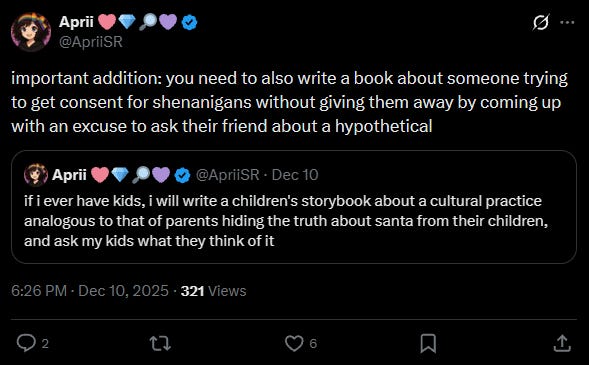
Bob is also familiar with Santa strats, infers the whole shape of the game, and finds the book distressing besides.
Calamity! Alice really should have foreseen this!
Alice thinks to herself that she should hurry up and become and/or make god, so she can predict Bob’s reactions to arbitrary questions.
Alice makes a perfect predictor, but it eats the universe to make more predictions.
Calamity! Alice was explicitly warned by people who did foresee this!
She was, admittedly, on the right track.
Bob has good enough theory of mind to predict that Alice might accidentally destroy all value in the lightcone if he doesn’t figure out a way to give her leave to ask him questions that might be distressing. Maybe Bob indicates particular times where it is less calamitous for him to be distressed or something, idk, I’m not Bob, or Alice.
Secrets
Asking about willingness to keep secrets is in some respects the exact opposite of asking about asking questions. When you ask about asking questions, there is a good chance you end up imposing the costs of actually asking the question on your counterparty with none of the benefits. Asking about inflicting a secret on someone typically does not impose the costs of actually inflicting the secret.
Recapitulating drama more vividly expressed on LessWrong about a bit ago, keeping a secret sucks, much like being asked about [SUBJECT] sucks for Bob. You have to remember to keep it for basically forever typically, you have to figure out how you would act if you didn’t know it in order to do a maximally good job, and if you forget or slip up, you’ve legibly wronged someone and don’t get to go to Axis when you die anymore, and that sucks too.
Being asked about your willingness to keep a secret imposes none* of the costs of having a secret inflicted on you. Because you do not know what the secret is, you cannot accidentally give it away even if you wanted to, so you have no cause to worry about forgetting to keep the secret. You already know how you would act without knowledge of the secret, and so on.
*Well, maybe some of the costs
Obviously, before accepting a responsibility to take on a secret, you probably want to know some information about the secret. How long does it have to be kept? How important is it that it be kept? How bad would it be if I slip up? Is it likely to come up in my day to day life? Is it likely to distress me? Do I have to completely screen it off from my behavior, to give no hint of my knowledge of it at all, or just avoid repeating the propositional content of it?
This is unfortunate, because as we all know from HPMOR, the most important fact about a secret is that it exists. Presumably we were supposed to interpret that along the lines of “knowing that a secret in a particular subject area exists” and not along the lines of “knowing that literally any secret exists anywhere”. What I mean to say is that the more you know about a secret, even without knowing its exact contents, the closer the situation functionally is to you just knowing Alice’s secret. But you need to know things about the secret to know if it is a good idea for you to promise Alice you will not tell anyone about Alice’s secret. But Alice would want you to keep the information about the secret, secret. But you wouldn’t want to commit to keeping Alice’s information about the secret, secret, because of the unbounded downside costs of keeping things secret, which remain unbounded unless you have information about the information about the secret. And so on up the chain.
Shards
As anyone who has read Planecrash can tell you, there is a trivial solution to this whole business. Alice and Bob should become as Gods and deploy disposable copies of themselves which can freely exchange all information with each other. Those shards should determine if the secret should be transferred from non-shard Alice to non-shard Bob, while operating with full information about the contents of the secret, and report back to non-shard Alice and non-shard Bob. Then the shards may be disposed of. In this manner nearly all costs can be averted. Alice has no cause to fear leaks at any level of meta, and if the secret proved too costly for Bob to accept, the only Bob-like entity who would ever learn the secret would be terminated before it had a chance to leak any bits.
Obviously we do not have a Starstone, but personality cloning onto LLMs might be a mature technology within the next couple decades, and that’s basically just as good.
Oh my goodness, at this rate I am going to become a reply guy glazer of this account. Good post!
I for one am happy to attempt this procedure even merely with modern LLMs.